This post may contain affiliate links.
In January I bought a food blog with almost 1,500 recipes on it. I had just spent 26 years in the car business, and I could not have told you what alt text was.
Megan Porta had me on the Eat Blog Talk podcast to tell the story. This post is the long version, including the numbers we did not have time to dig into on air.
The family side of the same year, the cooking shows, my daughters, and the one question that fixed things with Maddie, is in my Fuel Your Legacy episode write-up.
Listen to the Episode
The episode is 40 minutes. Play it right here, or find it on Apple Podcasts, Spotify, or the Eat Blog Talk website.
How a Car Guy Ends Up With a Food Blog
Here is the short version. Twenty six years in the automotive industry. Then cancer. Then a divorce. Then a job loss. My whole life got reset in a stretch I would not wish on anybody, and what came out of it was one question. What do I actually want? The answer was time with my daughters.
My plan was to buy a dealership and work alongside them there. God’s plan was different. A friend got me interested in buying cash flowing businesses, and my mentor Jeff, who is now my business partner, helped me vet eight or nine companies. P and Ls, bank statements, the books going back years. Then This Silly Girl’s Kitchen came across our desk after another buyer’s loan fell through.
Growing up, the one thing my girls and I could always agree on was cooking shows. We spent hours on that couch watching Guy’s Grocery Games. So when I told them about the blog, that was the whole pitch meeting. They said dad, we’re all in, let’s go.
Dana DeVolk, the founder, grew this site from day one, and she took me under her wing through the transition. I bought a batch of recipes from her and rebuilt them her way, post by post, which was the karate kid version of learning to run a food blog. Day one was January 21st. From that day forward it was drinking through a fire hose.
One more thing about timing. Two days after Megan and I recorded this episode, I dropped my oldest daughter off at college. The whole reason I bought this blog was time with my girls, and I got it. I would make the same trade a hundred times.
The 33 Page Audit That Changed Everything
Two weeks into owning the site, I asked our virtual assistant, who stayed on from Dana’s team, how do I learn this fast. She pointed me at food blogging podcasts, and one of the first episodes I hit was an SEO expert named Casey Markee. I listened once and told my partner, I need this guy in my life.
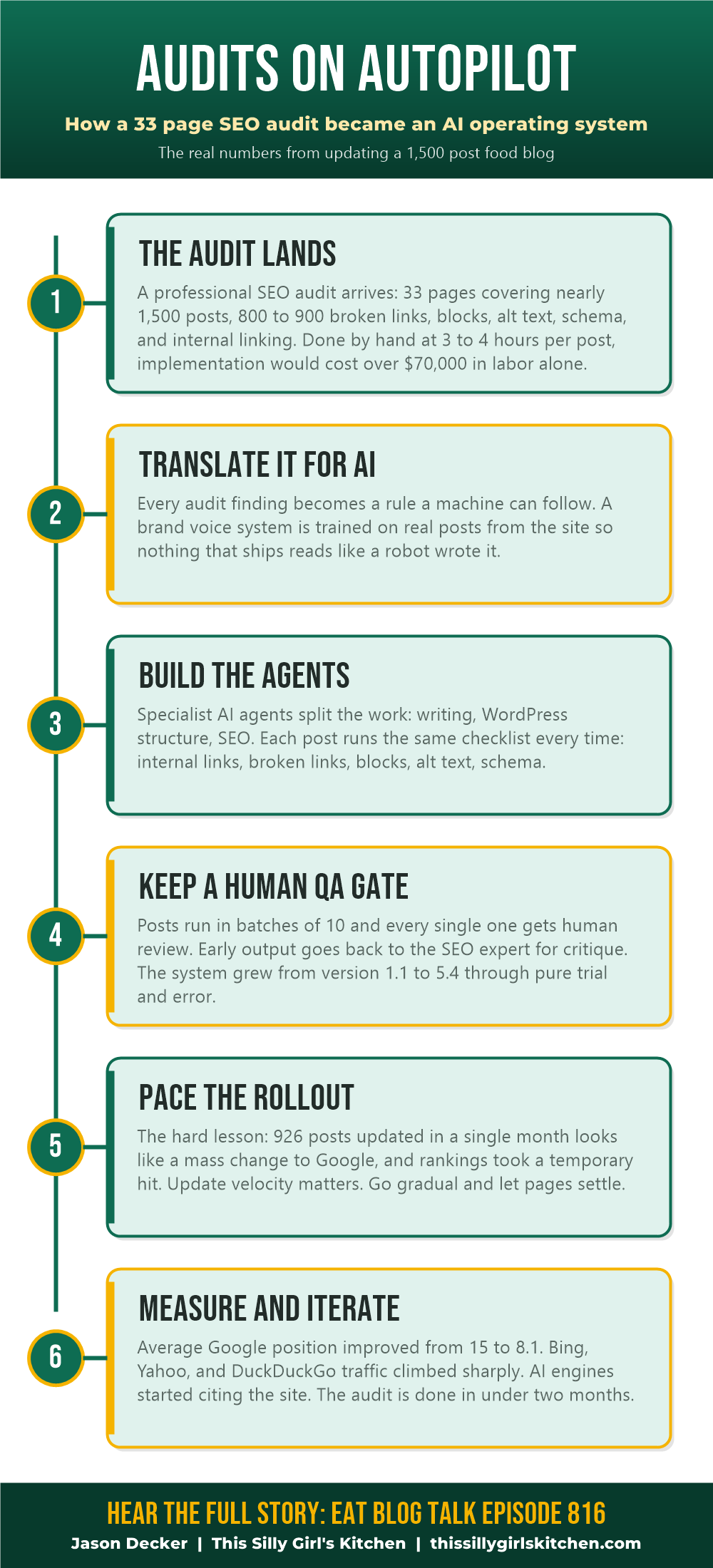
Casey books out about two months, and on April 10th we did our audit. What came back was 33 pages. Every post on the site needed work. Internal links. Broken links, and we had 800 to 900 of them. Blocks, alt text, schema, image structure, all of it, across close to 1,500 posts, including the ones readers love most like our Rice Pudding with Cooked Rice.
Casey gave me the analogy that finally made SEO click. Your blog is a maze, and Google is the rat running it. Broken links stop the rat. Pop ups stop the rat. Every dead end teaches Google your site is not worth crawling.
Then I did the math on fixing it. A great VA quoted me $50 a post, and honestly that is a fair price, because a proper rebuild is a three to four hour job. She could do two a day. At close to 1,500 posts that is over $70,000 and roughly two years of waiting. Add my own time and the real number is well past six figures.
I did not have six figures for it. So I built something instead.
Putting the Audit on Autopilot
On April 1st I took my first AI class. I am not exaggerating when I say I knew nothing. Within a couple of weeks I was obsessed.
Here is what I actually built, in plain English. I took Casey’s audit and turned every finding into a rule a machine can follow. I built specialist AI agents, one for writing, one for WordPress structure, one for SEO, and I trained a brand voice on our own posts so nothing that ships sounds like a robot. Then every post runs through the same checklist. Internal links, broken links, blocks, alt text, schema.
It was not magic. It was 16 hour days, usually dialed in from 7 pm to midnight, which for whatever reason is when everything worked. I would finish a post, send it to Casey, and he would go through it with a fine tooth comb and kick it back. The first post that came through done right was in late May. The system started at version 1.1. It is at 5.4 now, and every tenth of a version was something I got wrong first.
The part I refuse to automate is the review. Posts run in batches of 10 and I check every single one. One or two come out perfect. The rest have something, a picture in the wrong spot, a block off, and a human catches that in seconds.
The Mistake I Would Warn You About
Once the system worked, I ran hard. I updated 926 posts in June alone. And Google noticed, but not the way I wanted. When that many pages change that fast, it reads as a mass change, and between the May core update and the spam update we took a real hit on Google traffic. When I was updating slowly, we were climbing, solid double digits. At scale, we got smacked. A page cannot settle while its body keeps changing, and 926 posts in a month is a lot of unsettled pages.
I wrote up the full numbers on that separately, what recovered, what did not, and the update pace I would recommend instead: What Happens When You Update 926 Blog Posts in One Month.
Here is the flip side, and why I am not panicking. Our average Google position moved from 15 to 8.1, so the traffic we do get is worth more. Bing, Yahoo, and DuckDuckGo have shot up. Social has filled a big part of the gap. And AI engines have started citing the site, which is exactly what the audit’s E-E-A-T work was built for. The content is right. Google just needs time to trust it again.
So learn from me. Build the system, then pace the rollout. Speed is the one place I would pump the brakes.
Should You Buy a Blog or Start One
People ask me whether they should buy a blog or start one. My honest answer is know your why first, then go all in on whichever one fits it.
Starting from zero means you know every inch of what you build, but you are years from real traffic. Buying means day one revenue and an audience, and it means you had better vet it like your savings depend on it, because they do. We went through P and Ls, bank statements, and years of books before we signed anything.
And if you do buy one, embrace the creative part. The recipes, the pictures, the videos with your family crowded into the kitchen. That is the part that is actually fun, and it is the part that makes it yours.
Buying a Food Blog FAQs
It can be, if you vet it like a business and not a hobby. We reviewed eight or nine companies, went through profit and loss statements, bank statements, and years of books before choosing This Silly Girl’s Kitchen. Buying gets you revenue and an audience on day one, but be ready to learn SEO and content operations fast.
Our audit flagged work on close to 1,500 posts. A skilled virtual assistant quoted $50 per post at three to four hours each, which comes to over $70,000 and about two years of calendar time. That math is what pushed me to automate the work instead. I put the full cost model, a table by archive size and when each option makes sense, over at What It Actually Costs to Implement an SEO Audit.
Yes, with a human in the loop. I turned every audit finding into rules that AI agents follow for internal links, broken links, blocks, alt text, and schema, then reviewed every post in batches of 10. The full audit was finished in under two months. The human review step is the part I would never remove.
Building the system took hundreds of hours over about two months of trial and error. Once it worked, the entire catalog was updated in under two months. Doing it again, I would spread the updates over a longer window so Google never sees a mass change.
Temporarily, yes. Updating 926 posts in one month coincided with core and spam updates and our Google traffic dropped. At the same time our average position improved from 15 to 8.1, and Bing, Yahoo, and DuckDuckGo traffic rose sharply. Update velocity matters as much as update quality.
Ask for a free prep list at BlogPrep and we will send you what your site needs, no charge. If you have a professional audit sitting in a drawer because it feels overwhelming, the gap between the audit and the implementation is exactly what I automate.
Put Your Audit on Autopilot
If you have an audit sitting in a drawer because it reads like homework, that is exactly the problem I solve now. I put audits on autopilot. The system that rebuilt this site can rebuild yours, without the $70,000 and without the two years.
The whole system lives at BlogPrep now. Ask for a free prep list and we will run the numbers on your site and send you the findings within two days, no charge and no sales call. Even if you just want to bounce ideas, I mean it, reach out. People helped me when I knew nothing. I would love to pass that on.
Thanks to Megan and the Eat Blog Talk crew for having me. And if you take one thing from this whole story, take this. Nothing happens to you. Everything happens for you.